
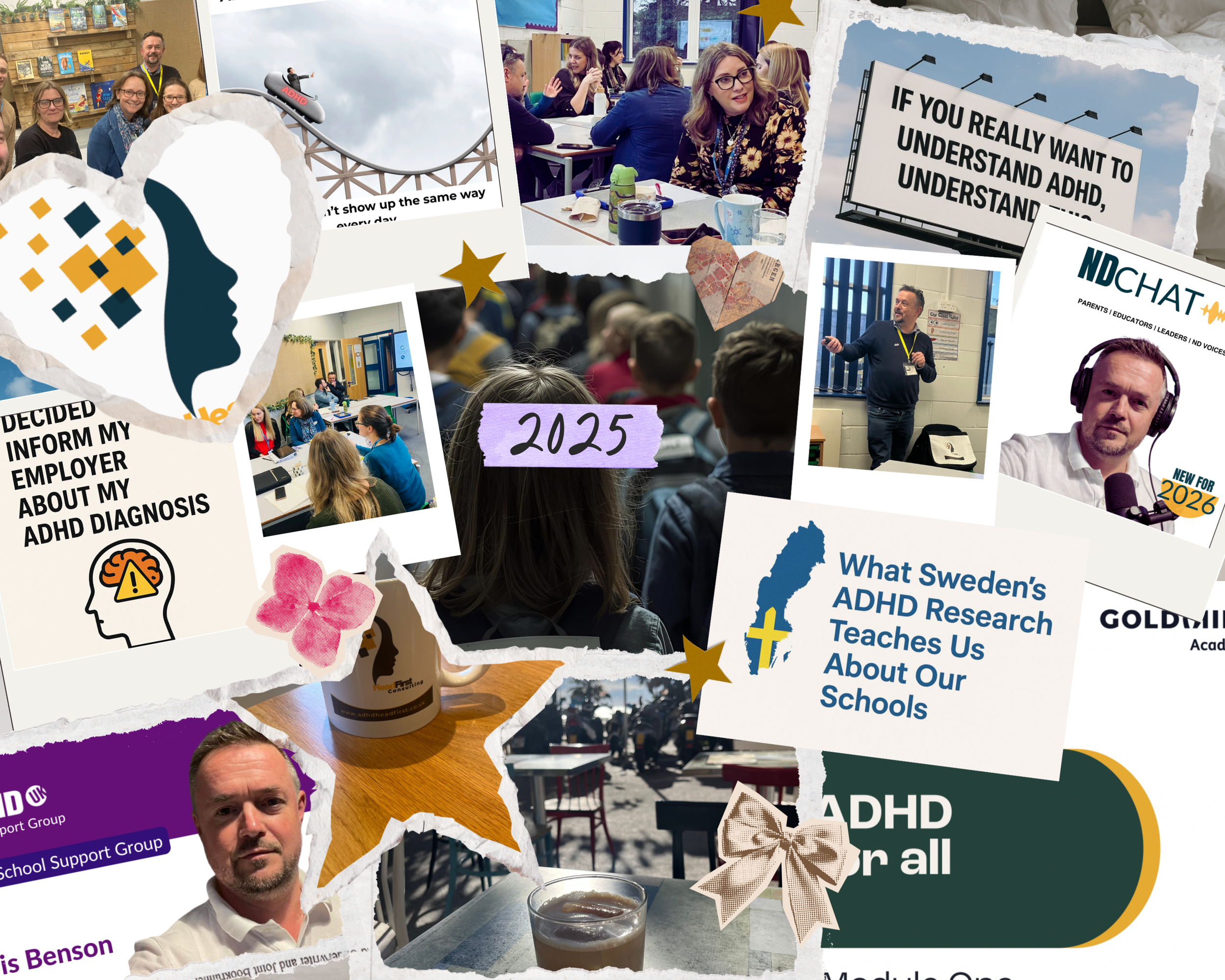
About Me
Hi, I’m Chris Benson. Much of my life has involved finding my way through school, then work and parenting, while processing and reacting to the world in ways that don’t neatly fit what is typically expected. That hasn’t made me unusual or exceptional, but it has shaped how I move through the world, how I relate to others, and how I make sense of myself.
ADHD and Me
I have ADHD. It doesn’t define me. It’s not my identity. It is part of who I am and has shaped much of my life.
For me, that hasn’t meant clear phases of doing well and then not. It’s meant daily inconsistency and contradiction — being capable and committed, yet uneven, and wired for interest and urgency rather than importance. Some things absorb me completely; others remain stubbornly hard no matter how much they matter to me. That tension has been a constant thread through my life.
Living like this has shaped more than how I work. It’s shaped how safe or exposed I feel in different environments, how easily I can regulate myself under pressure, and how I’ve come to understand my own self-perception and mental health over time — particularly when effort and outcome don’t line up neatly.
Curiosity About Difference
Alongside this, diversity and difference have never felt unfamiliar or threatening to me. They’ve been sources of curiosity and interest. I spent many years living and working in the south of France, becoming bilingual, raising my children there, and integrating into a culture that wasn’t my own. Working with international families and communities, I learned early on that there is rarely a single “normal” way of thinking, communicating, learning, or belonging — and that assumptions often tell us more about systems than about people.
Parenting and Responsibility
I’m also a parent to a son who is autistic and a daughter who has ADHD. Supporting them has brought both joy and responsibility, and it has placed me directly inside the realities families face when navigating education and health systems. I’ve felt lost and frustrated at times, particularly when systems felt complex, fragmented, or hard to access — often at the very moments when clarity mattered most.
Leadership and Systems
Alongside this, I’ve spent many years working in senior leadership roles, inside systems where decisions carry weight and where certainty is often expected even when it isn’t available. Living with ADHD, while also holding responsibility for others, has shaped my awareness of how environments can energise or unintentionally drain people, sometimes before the school or working day has even begun.
What I’ve Seen Over Time
Over more than 25 years in education, in the UK and internationally, I’ve seen the same pattern repeat. The same child or adult can thrive in one environment and struggle in another — not because of effort or ability, but because of how expectations, sensory demands, communication styles, and relationships interact with a person’s nervous system.
Behind systems and structures are real people — real families, real schools, and real workplaces.
Over time, I’ve seen how often neurodivergent people end up forging their own pathways, not out of preference, but because systems lack the flexibility and nuance to recognise and make use of their talents, perception, and insight.
Why I Do This Work
I chose to speak publicly about my own ADHD because I could see how often neurodiversity was discussed without being understood — reduced to labels, surface-level adjustments, or simplified narratives that miss its impact on self-perception, wellbeing, and mental health.
I don’t speak for all neurodivergent people, and I don’t try to. What my life and work have given me is a way of seeing — grounded in lived experience, cultural awareness, and professional responsibility — that pays attention to regulation, connection, and belonging, and to how decisions land in real human lives.
Through Head First Consulting, I now work with individuals and families, schools and educational settings, and organisations and trusts. Across all of this work, the focus is the same: helping people think more clearly about neurodivergence — not as something to fear or fix, but as part of human diversity that systems need to understand if people are to truly connect, contribute, and belong.
It’s the same reason I went into teaching in the first place: to do work that makes a positive, lasting difference to real people’s lives.